
Nightfall at Craig's Hut
An unforgettable night beneath the Milky Way in Victoria’s High Country
By Andres Peña | Fine Art Landscape & Adventure Photographer

A Photograph That Stayed With Me
Sometimes, the inspiration for a photograph begins long before we ever pick up a camera.
For years, I had walked past a beautiful panoramic photograph hanging on a wall at the hospital where I work. It was New Horizons, by renowned Australian landscape photographer Ken Duncan, depicting an old timber hut surrounded by the rugged mountains of Victoria’s High Country.
There was something about that photograph that always caught my attention.
I have always been drawn to old buildings, isolated places and landscapes that seem to carry stories from another time. The weathered timber, the surrounding mountains and the apparent remoteness of Craig’s Hut made it somewhere I wanted to experience for myself.
But I imagined it differently.
Instead of the expansive daytime landscape in Ken Duncan’s photograph, I wondered what this historic-looking hut might look like beneath the Milky Way, surrounded by darkness, with the stars stretching high above its roof.
The idea stayed with me. Eventually, I decided it was time to find out.
Into Victoria’s High Country
Craig’s Hut sits high in the Victorian Alps, within Alpine National Park. Originally constructed as a film set for The Man from Snowy River, it has become one of the most recognisable landmarks in the region.
Although the building itself isn't a historic cattlemen’s hut, it represents an important part of Australia's High Country heritage.
Getting there, however, required more preparation than I initially expected.
I spent considerable time researching access roads, walking tracks and possible photographic locations. Information about reaching the hut wasn't always clear, particularly because I intended to visit at night.
I knew that I could drive part of the way and walk the remaining distance, but I wasn't entirely sure what the track would be like or how difficult the climb might become in darkness.
So I made an important decision. Before attempting the night photograph, I would walk to the hut during daylight, scout my compositions and familiarise myself with the route. It turned out to be a very wet introduction to the Victorian Alps.
The rain was relentless.
After parking my car near the beginning of the walking track, I started climbing towards Craig’s Hut. The path was narrow, muddy and not particularly well defined in places. With the rain continuing, I became completely soaked.
The uphill journey took a little over an hour, and although I was enjoying the experience, I was also conscious that I would need to repeat the walk later that night.
If the weather improved. That was far from certain.
When I finally reached the hut, I felt an enormous sense of relief. I had found the location, confirmed the route and could begin exploring possible compositions.
I walked around the building, studied the surrounding landscape and identified several positions from which I could photograph the Milky Way.
But looking at the thick clouds overhead, I couldn't help wondering whether all this preparation would be for nothing.
I had only two nights in the region. And the weather was showing no signs of cooperating.


Craig's Hut during the daytime reconnaissance, surrounded by rain and low cloud.
After the rain-soaked scouting walk to Craig's Hut.
A Small Window in the Weather
After returning from the scouting walk, I headed back towards my accommodation in the alpine village at the top of Mount Buller, where I was staying among the holiday apartments.
I was tired, wet and somewhat discouraged.
Mountain weather can be notoriously unpredictable, and although forecasts are useful, they don't always reflect the rapidly changing conditions at higher elevations. I decided to get some sleep and reassess the situation later.
When I woke that evening, the weather appeared slightly more promising. There were still clouds, but I could see some stars.
I found myself facing a difficult decision. I was tired after the day's strenuous walk, and the weather had been miserable for most of the day. The thought of spending another two hours driving through isolated mountain roads, potentially getting lost or bogged in the mud, wasn't particularly appealing.
And even if I reached the parking area safely, I still had another hour of walking uphill, carrying all my photographic equipment, with absolutely no guarantee that the skies would remain clear.
I could easily have arrived at Craig's Hut to find myself standing in the rain again.
Part of me wondered whether I should simply stay at the accommodation and try again the following night.
But another part of me—the part that has always loved adventure, remote landscapes and the possibility of capturing something extraordinary—wasn't ready to give up.
I had travelled a long way to be there. And something told me it was worth taking the chance.
So, despite the tiredness and uncertainty, I made my decision. All right. Let's do it.
Looking back, I'm incredibly grateful that I did.
I gathered my photographic equipment, checked my supplies and began the drive back towards the mountain.
The journey involved descending from the resort area and following winding gravel roads through the forest towards the parking area. It was an interesting drive.
There were no streetlights, very few signs of civilisation, and several road junctions where I needed to pay attention to ensure I was heading in the right direction.
Driving alone through an isolated forest at night always brings a mixture of excitement and caution.
You become acutely aware of how far you are from everything.
A wrong turn, a mechanical problem or an unexpected change in conditions could make things considerably more complicated.
But I kept going. And when I finally reached the parking area and stepped out of the car, I could hardly believe what I saw. The clouds had disappeared.
Above me was an extraordinary sky, filled with stars. The atmosphere had that beautiful deep-blue darkness that I love so much, and the visibility was remarkably clear.
After an entire day of rain, there it was. The opportunity I had travelled so far to find.
I remember looking up and thinking:
This is going to be the night.
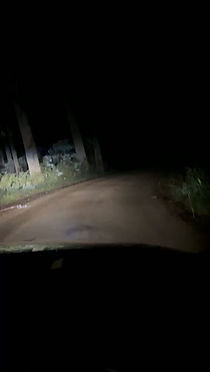
Driving through the isolated forest roads of Victoria's High Country on the night of the photograph
Alone Beneath the Stars
With more than ten kilograms of photographic equipment on my back, I began the climb.
The same muddy track I had struggled along during the day now disappeared into darkness. Carrying that much equipment uphill for approximately an hour added another challenge, particularly after an already exhausting day.
But the extraordinary sky above me made the effort feel worthwhile.
I prefer using relatively subdued lighting when walking at night, partly because I enjoy allowing my eyes to adjust to the surroundings and experiencing the landscape without excessive artificial illumination.
So I made my way uphill with a faint torch, following the route I had carefully observed during my earlier scouting expedition.
It was exciting, but also a little unnerving.
The forest was almost completely silent, the track was muddy, and I knew that losing my way in the Victorian Alps at night was something I needed to avoid.
Occasionally, I would recognise a section of the path or a particular feature of the landscape.
Those familiar details reassured me that I was heading in the right direction. After approximately another hour of walking, I finally arrived.
Craig’s Hut stood silently against the darkness.
There were no other photographers, no campers that I could see, no voices, no distant lights. Just the hut, the surrounding mountains and an extraordinary sky.
I felt completely alone, and for me, that was part of the magic.
There is something difficult to describe about being in a remote location at night, far from the noise and distractions of everyday life, watching the stars above an otherwise silent landscape.
It is one of the reasons I love landscape astrophotography so much.
The solitude allows me to connect with a place in a way that is difficult to experience during the day.
And standing beside Craig’s Hut that night, I knew I was exactly where I wanted to be.

The narrow mountain track during my nighttime ascent to Craig's Hut, illuminated only by my torch.
Photographing the Impossible Darkness
I had already planned several compositions during my scouting walk, so I knew approximately where I wanted to position my camera.
The Milky Way was spectacular.
Its bright Galactic Centre rose behind the hut, while the surrounding stars stretched across the dark alpine sky.
The scene was everything I had imagined.
I set up my Canon EOS R6 Mark II and began working.
One of the greatest challenges in astrophotography is balancing the exposure of the night sky with the landscape beneath it.
The stars are constantly moving across the sky because of Earth's rotation.
Capturing them as relatively sharp points requires exposures short enough to minimise visible trails.
The foreground, however, needs considerably more light.
And at Craig’s Hut, the surrounding landscape was extremely dark.
Rather than trying to capture everything in a single exposure, I decided to photograph the sky and the foreground separately.
For the Milky Way, I used exposures of approximately 15–20 seconds.
For the hut and surrounding vegetation, I made much longer exposures, sometimes lasting between two and five minutes, allowing me to use a lower ISO and capture more detail with less noise.
This required patience.
A five-minute exposure might not sound particularly long, but when you're standing alone in the cold, surrounded by complete darkness, time seems to move differently.
Between exposures, I would look up at the Milky Way, check my compositions and simply enjoy being there.
Everything was working, the sky was clear, the camera was performing beautifully.
And the compositions I had planned earlier were coming together.
I moved between two or three positions around the hut, photographing the different relationships between the building, surrounding landscape and stars.
I didn't feel any need to radically change my original plan.
For once, the preparation, weather and photographic conditions seemed to align perfectly. I was incredibly grateful.
Little did I know that the peaceful atmosphere was about to change.


My camera setup at Craig's Hut during the nighttime photography session.
Craig's Hut briefly illuminated for a few seconds to document the photography session. No artificial lighting was used to create the final Milky Way photograph.
Something in the Darkness
I was approaching the end of my photography session when something happened that I still cannot explain.
Out of nowhere, I heard a sound. A horrible, deep, animal-like growling noise.
I've spent countless nights photographing in remote locations, often completely alone. Over the years, I've become accustomed to the sounds of the natural world after dark. Wildlife moving through vegetation, unfamiliar calls, sudden noises in the distance—these are all part of being outdoors at night. Normally, they don't particularly worry me.
But this was different. I had never heard anything quite like it.
It was a deep, frightening, animal-like growl, and I couldn't associate it with any wildlife sound I recognised.
Perhaps it was an animal. Perhaps there was another explanation.
To this day, I genuinely don't know.
What I do remember is how unexpectedly frightened I felt. At first, I wondered whether someone might be making the noise to frighten me. But I hadn't seen another person anywhere near the hut. And everything around me was completely dark.
For a moment, I didn't know what to do. I was reluctant to switch on my powerful torches because I didn't particularly want to reveal my position to whatever might be out there.
But the sound was genuinely frightening. Eventually, I turned on my lights and searched the surrounding area.
Nothing. No animals, no people, no movement that I could see. Absolutely nothing.
I still had no idea what had made the noise. And somehow, that made it even more unsettling.
There is something extraordinary about how your mind behaves when you are alone in complete darkness.
A sound that might be relatively unremarkable during the day can suddenly become terrifying when you cannot see what is producing it.
Every possibility seems more threatening.
I decided that I had taken enough photographs for the night.
It was time to leave. And I packed my equipment remarkably quickly. Normally, I carefully secure my tripod to the outside of my camera bag before walking.
Not this time. I kept it in my hand.
My thinking, perhaps not particularly sophisticated at that moment, was that if some unknown creature appeared on the track, at least I would have something with which to defend myself.
I can laugh about that now. At the time, however, it seemed like a perfectly reasonable precaution.
Then I started down the mountain.
Fast, very fast.
As I hurried down the mountain, I became unusually aware of every sound around me.
A rustle in the vegetation, an unfamiliar noise somewhere in the darkness, the sensation that something might be moving nearby. At the time, I couldn't shake the feeling that something was following me.
But I know now that it was my imagination, fuelled by adrenaline and the uncertainty of what I'd heard earlier. There was nothing pursuing me. It's extraordinary how the mind can transform an otherwise familiar environment when fear takes over.
I've walked alone in remote locations at night many times, but that particular descent showed me just how powerful our imagination can become when we cannot see what's around us.
Looking back, I find the experience quite funny. At the time, however, I was holding on to that tripod rather tightly. In fact, the descent happened so quickly that I don't remember much of it in detail.
I was simply concentrating on getting back to the car. With my camera equipment on my back.
And my tripod firmly in my hand.
The Long Drive Back
Reaching the car brought a welcome sense of relief.
But the adventure wasn't quite over.
I still had to navigate the winding forest roads back towards my accommodation.
The drive was another reminder of how isolated the location really was.
The headlights illuminated only a small section of the road ahead, while the surrounding forest disappeared into darkness.
At several junctions, I needed to make sure I followed the correct route.
And somewhere along the way, I encountered a small animal running along the road ahead of me.
I thought it might have been a fox.
I even managed to capture a short video of it.
It was another unexpected encounter on what had already become a very memorable night.
Eventually, I made my way out of the forest and back to my accommodation.
I had travelled to Craig’s Hut hoping to photograph the Milky Way.
Instead, I had returned with a beautiful photograph, a frightening experience and a story that I would continue telling for years.
As for that mysterious sound?
I still have absolutely no idea what it was.
And perhaps I never will.

An unexpected wildlife encounter during the return drive through Victoria's High Country. I thought the animal might have been a fox.
The Photograph That Made It All Worthwhile
The following day, the weather returned to what it had been during my whole stay at Mt Buttler. Rain, fog, clouds. The mountains once again disappeared beneath unsettled skies.
Looking back, I realised just how fortunate I had been.
During my short stay in the region, that one night had provided the clear conditions I needed. A relatively brief window between periods of poor weather. Had I decided not to make the journey that evening, I might have returned home without the photograph I had travelled so far to create.
Instead, I captured an image that remains one of my favourite photographs.
The finished composition brings together two things I love: the character of an old timber hut and the extraordinary beauty of the Milky Way.
It has since received recognition within the photographic community, including being used by the Australian Photographic Society to promote photography competitions.
But the recognition is only one part of what makes this photograph special to me.
When I look at it, I don't simply see Craig’s Hut beneath the stars.
I remember the rain, the muddy track, the uncertainty.
The moment I stepped out of the car and discovered that the sky had cleared. The silence of the mountains. The satisfaction of watching the photograph come together. And, of course, that mysterious growl in the darkness.
Every part of the experience is connected to the image. And perhaps that is what makes photography so meaningful to me.
A photograph is not always just a record of a place. Sometimes, it becomes a record of everything we experienced while trying to capture it.
Would I Go Back?
Absolutely.
In fact, returning to Craig's Hut is already on my list of photographic adventures for next year, 2027.
I want to walk that mountain track again, experience the solitude of the Victorian Alps and photograph the hut beneath the Milky Way with everything I've learned since my first visit.
My photographic knowledge and equipment have evolved considerably since that night.
Today, I would approach the scene with additional techniques, including using a star tracker to capture greater detail in the Milky Way.
I would still use long exposures for the hut and foreground, preserving the atmosphere and texture of the building.
But I would also experiment with subtle, carefully controlled light painting to see whether I could reveal more of its character while maintaining a natural-looking night scene.
Perhaps I could create an even better photograph. Or perhaps the conditions would never align quite as perfectly again.
That's one of the fascinating things about landscape photography. Even when we return to exactly the same location, we never truly experience the same moment twice. The weather changes, the light changes, our experience changes.
And we change as photographers.
So next year, if everything goes to plan, I'll be heading back into Victoria's High Country.
Perhaps I'll return with an even better photograph. Perhaps I'll simply enjoy another extraordinary night beneath the stars. Either way, I know the experience will be worth pursuing.
And this time, I might keep my tripod a little closer.
Just in case.
Behind the Photograph
How I Photographed Craig’s Hut Beneath the Milky Way
Camera: Canon EOS R6 Mark II
Location: Craig’s Hut, Alpine National Park, Victoria
Time of year: April
Technique: Separate sky and foreground exposures, blended in post-processing
Photographing Craig’s Hut at night presented a familiar astrophotography challenge: capturing detail in an extremely dark foreground while preserving the sharpness of the stars.
For this composition, I used two separate exposure strategies.
The Milky Way: Approximately 15–20-second exposures allowed me to capture the stars while limiting visible movement caused by Earth's rotation.
The foreground: Longer exposures, between approximately two and five minutes, allowed more light to reach the sensor. This helped reveal the timber structure, vegetation and surrounding landscape while keeping the ISO relatively low.
The longer foreground exposures naturally recorded star trails in the sky. This wasn't a problem because the sky and foreground would ultimately be combined.
During post-processing, I blended the exposures to preserve the detail of the hut alongside the clarity of the Milky Way.
The result reflects the atmosphere I experienced that night, while revealing details that were difficult for my eyes to distinguish in the darkness.
I briefly illuminated Craig's Hut with a torch for a few seconds to document the photography session. This was not part of the exposures used to create the finished photograph, which relied on natural ambient light rather than light painting.
Today, I would consider adding a star tracker for the sky and experimenting with subtle light painting for the hut. However, I would still aim to retain the natural darkness and isolation that made the original experience so memorable.

Short exposure showing the Milky Way and dark hut silhouette

Long exposure revealing the hut and landscape, with star trails

Final blended image combining the sky and foreground